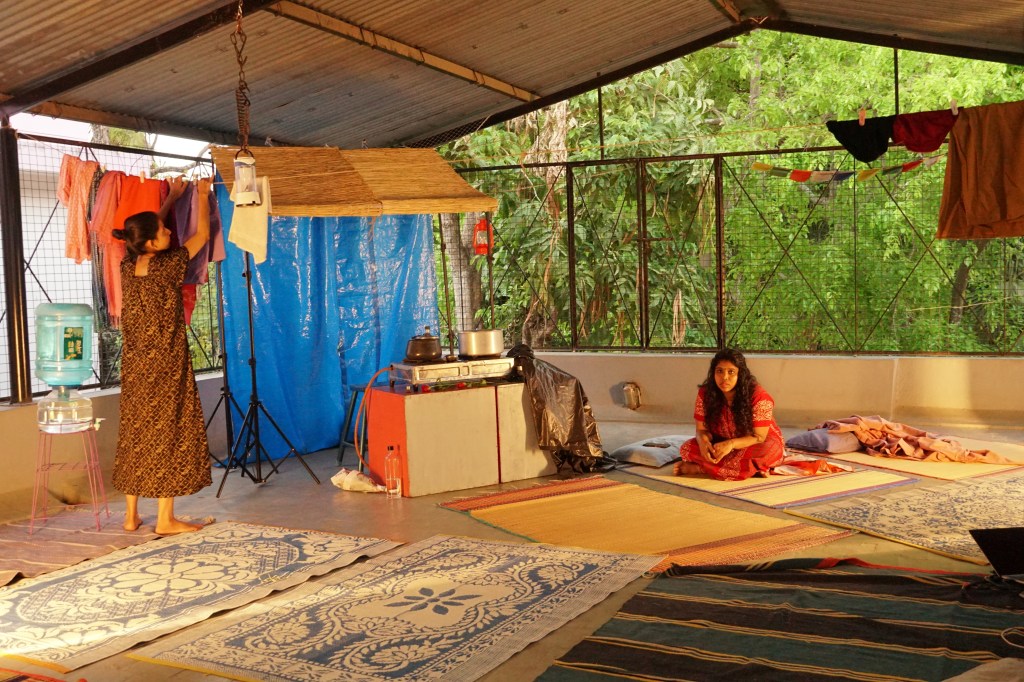
Show 2: 10 March, 2023. Maraa Collective Terrace, Indira Nagar, Bengaluru
The first show happened on the terrace of Maraa Collective. They had graciously agreed to house us in premises of the collective. Some of us took the train. Aparnaa was already in Bangalore. Krishna and I drove down to Bangalore with the set materials. Some day, I got to learn, get a jeep, and drive her across the world. As we went, I kept wondering what kind of different experiences, crises and problems we’re going to meet and with that anxiety, I had my own words, “Fuck it! We’ll figure it out.”

When we landed up at the Maraa Collective house at Indira Nagar, we were greeted by all of them and felt at home with the cook Geeta, who spoke Tamil, and made wonderful sambar. It is a very Tamil or Chennai thing. We like our sambar a particular way. We like our Bangalore for a few days. We like the sound of familiar languages that feel like home. I am sure that the reverse would be true for the Bangalorean who comes to Chennai, and they will miss the sweetness in our sambar.
When we freshened up, got some shut eye and prepared for the show – some of the cast had immediately regressed to previous techniques – they had started running lines. See, each of the four performers come from different walks of life. Some of them known each other before. Aparnaa, Atchaya and Nimmy come from varying amounts and types of traditional performance and dance training. They are a bit set in their ways in certain things – like running lines. They feel this makes them feel prepared for a show. But, I look at this differently.
Preparation needs to be specified to what we are preparing for. If we prepare for “performing”, we will end up “performing”. The Mobile Girls Koottam is not meant to be performed. Moreover, there are a lot of things in general that people do not take into consideration when preparing.

First and foremost, we had a new musician, Naren, a wonderful Parai artist and percussionist, a man with such a gentle heart. He was trying to capture a sense of the play and what was needed. It was fine to run the lines once for him to get an idea of everything the play talked about.
But in preparation there needs to first be introspection. When you prepare purely just to perform, you end up completely detaching from the piece. It is true that some amount of mental thought goes into it – each actor had had their personal conversation with me to let me know the phase of life they are in general and how they have walked into the rehearsal and tour space this week.
The danger of thinking our methods are the right ways is the blindness to the fourth performer who has not come from this training and does not have the tools or privilege to question if this is the right preparation needed for her. When Selvi runs her lines more than once, in fact, it tips her into panic that she might forget a few lines. It puts her into a space of trying to win the approval of the “experienced” performers.
But, this completely defeats the need to make a play like this. Why doesn’t the play happen on the factory floor? Why doesn’t the play have elaborately staged and choreographed scenes? What is the play trying to adapt to? The play is trying to be more than a piece of production. It is trying to be a “being”.
I kind of snapped at the performers for not asking for my guidance in this and then had to take a break so I don’t blow off my top at them completely. Did they remember the previous performance? Was the real issue with the previous performance that they forgot their lines or was it that they were trying to be so focused on “performing” their lines that the audience was somehow still alienated from the experience? This required some hard conversations.
From asking why are we doing the play, I started having conversations about what the audience means to us in this play. I had somehow simplified it down to we are here to get stories from people in the previous show. I needed to get deeper with my answers and questions. There were some quite off-putting answers to me that almost brought down the audience to props that we are using to form a narrative. I found violence in this approach. Of course, I was also a bit violent with my tone in making the cast try to detour it into another space and viewpoint.
Don’t mistake me. The text is important. But, subtext rules. When you know your subtext, it becomes almost impossible to forget lines and even if you do, you can find a thousand different ways to say what you want to say, because your heart knows what you want to say.
Before we got into the depth of this, I had to first fix parts of it to give them more anchors in the play. The songs are the pure anchors of the play.
Srijith could not travel with us to Bangalore. But, we still wanted Nooramma to travel with us. It has been over fifteen years since I have been okay with singing in my own plays in India. I broke out of the shell and decided to accompany the actors and give them some vocal backing. The discussions grew into me subbing for Srijith, who played the auto driver delivering Nooramma’s biryani in the last show. Our queer senses took over in these set of shows. I became the auto-driver. Here a very organic intersectionality built itself into the narrative as our queer selves found expressions in understanding love as fluid.
The other very beautiful thing was that my daughter, our production manager, Yazhini Manorama, had quietly packed herself a couple of nighties for the trip. She wore them for the rehearsals and helped Abhinaya make the biryani. She came up with putting black wool in the vessels, so the biryani will look burnt if anyone looks in to it. She knew everybody’s lines and all the songs. She was given the lines to introduce the show. During the show, she never exited the house and became a part of the women, which she continued for the next set of shows. The actors had to improvise along with her and she truly started breaking the barrier that I had been trying to break. She became the next door neighbour’s child who was left there, so her mother could go out and ride her auto. The idea of sisterhood of working women became larger.

We quickly changed up the chorus of the songs and made them feel more powerful, with the help of Naren’s wonderful percussion. Then, there was a choreography bit to fix in the beginning, the dream scene with the assembly line. We had no time to crack that for the previous show. And this time, it just came to us. To the rhythm of spelling out M-O-B-I-L-E we built the idea of the assembly line, the love story, the annoying supervisor, the pain of having periods in the work place all into one scene. I love moments like this. Synergies in simplicities.
The conversations with Ekta, Angarika and Nihal helped me think further into the whys and hows of what we try to do with such practices and processes. Why go this way? Why not the tested ways? What are we truly trying to do in society with our art?
Once all of this had been fixed, was the real showdown. It started with first changing up the seating. The seating in the first show was very alienating and the ways of participating became the traditional kinds of “audience interaction”, where people walked into the audience and pulled up people for conversations. At Maraa, we opened the floor. The audience could sit anywhere. Even behind us, near our kitchen.
One other thing, I ended up serving all the tea and coffee mostly in the first show. Now, I had taken up responsibilities of being a part of the play totally with accompanying songs and dropping in at the last with food for them. We had developed the character into a next door neighbour that Lakshmi has eyes for. These are liberties the story can take as it starts to encompass the truths of the women who will continue to interact with it.
From being a honest portrayal of the actual Mobile Girls, the girls become a space for women to be women as they are, intersectionally.
Anyway, I was not going to be serving the tea, which meant I was going to tell the audience that this is their house and they are very welcome to come and help us serve each other.
Now, who usually watches shows in Maraa? Maraa does house a very intersectional crowd and body of work. So, they immediately took us to the basti nearby with Naren. The actors sang and invited them for the show.
In between all of this, there is another reality in Bangalore. The reality of hegemony, which was right next door, with a saffron lotus flag on its gate. They had several issues throughout our stay and Maraa’s stay there. They had issues with people from the bastis coming into the house, with people making “noise”, with people smoking, with people making art. This was a conversation we instigated and witnessed through the week, but had to stay passive in, how much ever we felt at home in Maraa, because we would be leaving at the end of the week.
When the show started, the audience was sitting everywhere. The showdown before the show had kind of shifted the actors’ perspective of how they invited the audience. They slowly started perceiving the audience as guests in their house, a bit more than guests. You are never yourself in front of guests. They were friends who had come home. Friends who are ready to make space for the raw honesties of life. This started to ease them. I can with no doubt say that this was one of our tightest shows. The energy Maraa gave us and the way the hearts of the audience received us was purely magical. But somewhere in a little way, for me the “interaction” still felt like “interaction”. As I talk about the rest of the shows, I will try to articulate this more.
The end of show interaction section had a variety of comments and feedback. The women from the basti, our dear Geeta akka, purely felt at home in the play and felt it talked their truth. They shared their experiences and what it meant to lose a job and find resilience while the system treated them as if they are invisible props. People from other walks of life had had a wonderful evening and were more curious about certain aspects of factory work and whether we could discuss more about that, and show them more of the Mobile Girls’ world. The play is an opening, not an information bulletin or documentary.
It was a show that deserved to be celebrated in the night as we sat at the bar discussing our bodies of work and being as human beings, the things we needed to study, the way need to broaden our understandings. There had been a recent allegation of sexual harassment in a very well-known theatre group in Tamil Nadu that was on our minds. How do we create safe spaces? What are the checkpoints to create these safe spaces? Where can we move from “apologising” and “enabling it”? How do we deepen our work? How we do form a deep understanding of Marxist theory? Is there space to create a “post-work” dialogue?
Let’s come back to this word “work”. Is work something that pays you? Is work something purely done for survival? What about all the unpaid and underpaid labour? Where does creative labour fall within this? Why are the frameworks that support creative labour built on the same prejudices that it wants to break?
If someone like Selvi wanted to apply for a grant to study dance and develop her play on working in a textile shop, how does she access that? Without that access, how would she even feel the space to dream of doing that? Having gotten that space, if that space itself is filled with skill-based obstacles and a barrage of set ways in which she would have to attain these goals and prove how she attained those goals, where is the space for her to truly grow a practice out of what she wants to do?
But, if we remove all of these structures, would we be creating a system of anarchy or worse just pure chaos and zero direction? A system of undisciplined artists who do not get their work done at all? I often see it is the structure that burns out the artist or rather an inability to be authentic in a structure. What is the middle road of truly supporting artists to bloom in our society? Why approach it like how other industries approach “production” and “productivity”? Are artists this patient with the rest of the labour that happens around them, like the auto driver and the delivery person? Can art ever be labour? If so, what labour is it, in the age of not just mechanical reproduction, but AI production?
 The Mobile Girls Koottam
Leave a comment