
31 August 2023, out-of-line, falling through the lines exhibition, FICA, New Delhi
‘Out-of-line is a virtual exhibition space that employs the mobile device and the act of calling to showcase sound and text-based works by artists.‘
One of the curators, Suvani Suri, had gotten in touch with Madhu and me after reading the book. They had heard about the play through John Xavier in India Foundation for the Arts and were curious to make it a part of the interactions in their exhibition at the FICA Reading Room. Over some gentle conversations across our scattered schedules, I wanted to find a very organic way that did not feel like a presentation. I did not know if I wanted to create something with the audience. We could not take the entire play that soon to Delhi, but we wanted to find some way that people could experience everything that the processes of the Mobile Girls Koottam stands for. At the same time, I wanted to keep mind space open to learn from other artistic interventions and dialogues.
We collected some prompts to understand where the conversation could go – form fluidity, artistic devices as research, the site of the Nokia factory as where the Mobile girls inquiry shapes and evolves, rest, exhaustion, toil, ‘output’, the loading lines, hierarchies, dynamics of the group, conflict around ‘what work is more work’, this set against the backdrop of housework and uncompensated gendered labour, and the bringing together of how this places within the investigations of the out-of-line exhibition.
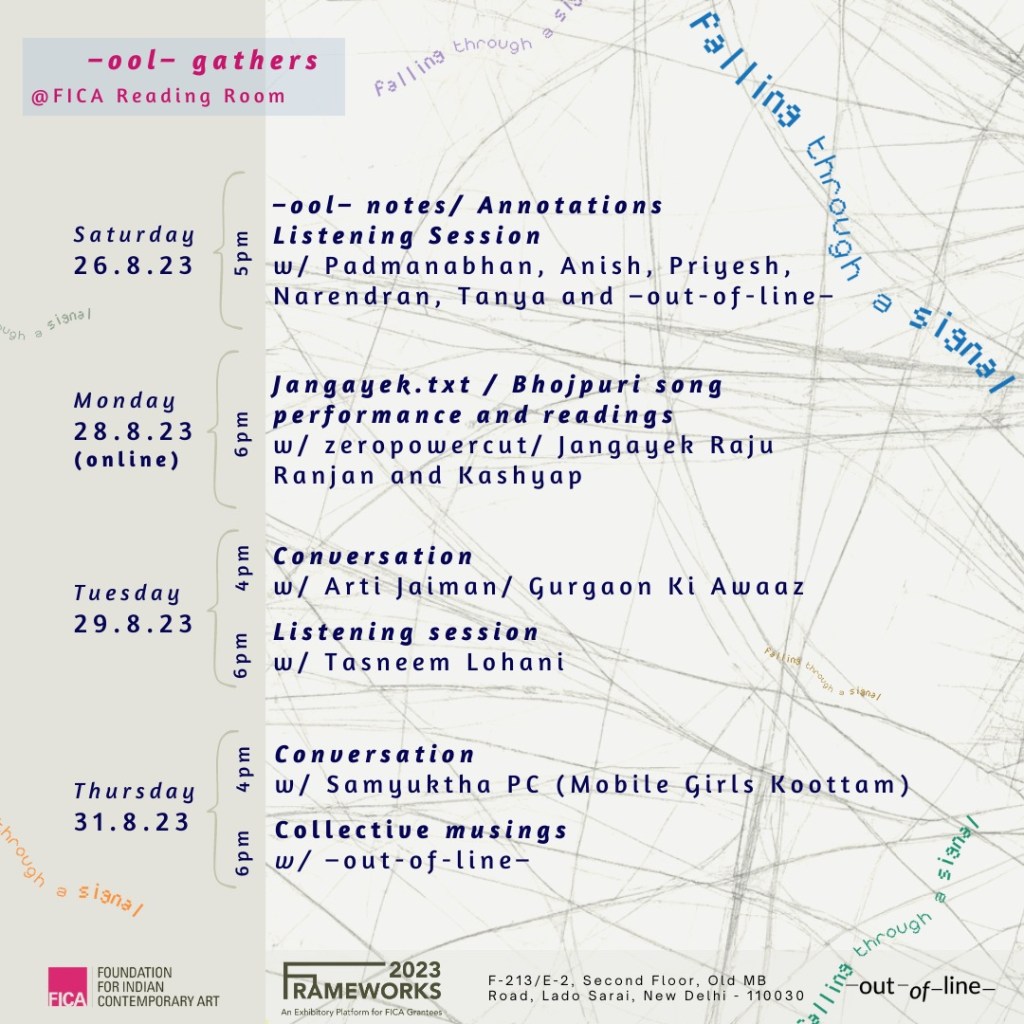
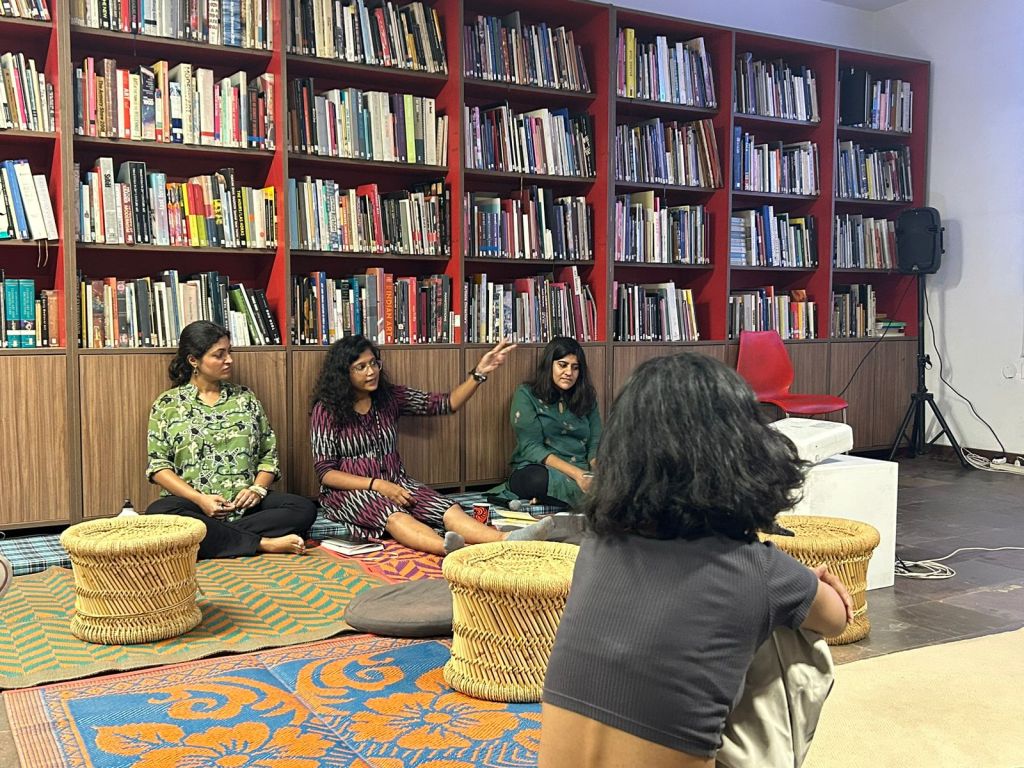
Along with the curators, we did a small reading of the chapter “We are all Suffering, Standing at the Loading Line” from the book about working in the assembly lines, while the video of the play ran in the background. Then, we threw open the floor for a free-flowing discussion on access points of arts and political activism and the way it interacts with creating stages for lived experiences of the labour community.
The conversation traveled through Madhumita’s research, meeting women and men workers, mapping the factory floor, and how our days in the Kanchipuram house turned into a podcast, and then slowly gave space to the thesis, the book and the play. Especially, we explored way in which Madhumita and the Mobile Girls opened up the research for more than interpretations or off-shoots, creating space for being human and growing with the Koottam. It was interesting to retrospect on the journey of how we got here, on building ears for humour, intimacy, and honesty… on learning to listen.
In between this conversation, I was at the height of my periodical artistic existential crisis of what I was doing with my life and whether my energies were going into the right places or if I had burned myself out into a space where I felt misunderstood everywhere. Sometimes a day job and the infrastructure of an office, along-with the security it provides, can also seed insecurities within us.
See, through this year of creating MGK, doing my full-time job as a script reader and curator, making my stuff, writing my stuff, taking care of my family and more, I had spread myself thin, constantly waking up with newer ideas that needed to be started and launched out into the world along with all of this. There was a space where my mind went into overdrive. The ideas of how people were looking at the idea of “work” and “professionalism” was getting confrontational and causing dissonance. A lot of what I spoke to Suvani came from finding this authenticity in our work. Again, this whole word – WORK – started to morph in my head.
The tea, Mobile Girls Koottam, is now put in a brewing stage. We are slowly gearing towards getting the momentum to perform this in some community halls in Chennai towards the end of the year. We let each other live in our peace and chaos for a while. Actors and crew needed to recuperate. Health issues were affecting bodies and minds.
If I purely approach commitment to Mobile Girls Koottam as something more paramount than the actual humans who are a part of this, then there is no point to this play. There is no point to the artistic practice that is being developed through this.
I had to first make space for the human in me. The human who feels dead while living some times. The human who is running from pillar to post figuring out responsibilities, putting out fires inside and outside, and refusing to run a rat race that we are constantly pitted against. A human who is denying herself the energy and care she gives. What is the point of not giving that space to take care of all of these things so we can truly approach the play in the way we need to with all these learnings? This put aside, what is the supportive and sustainable structure that can be built to allow this show and its multifaceted expressions travel to more communities?
One of the things we are slowly working on is to figure out other collaborations that can actualise the idea of real teashops and a caravan. We are also trying to figure out ways to organise shows in Mumbai and Delhi, amongst other things. We are trying to see if the play and everything we are humans and artists, queer and fluid, needs an umbrella over our heads. No, none of this is happening in the systemised scrum or assembly line manner. It is happening in a human manner. More on this later, as the things take shape in the next leg of this. The tea is brewing… into a strong decoction…
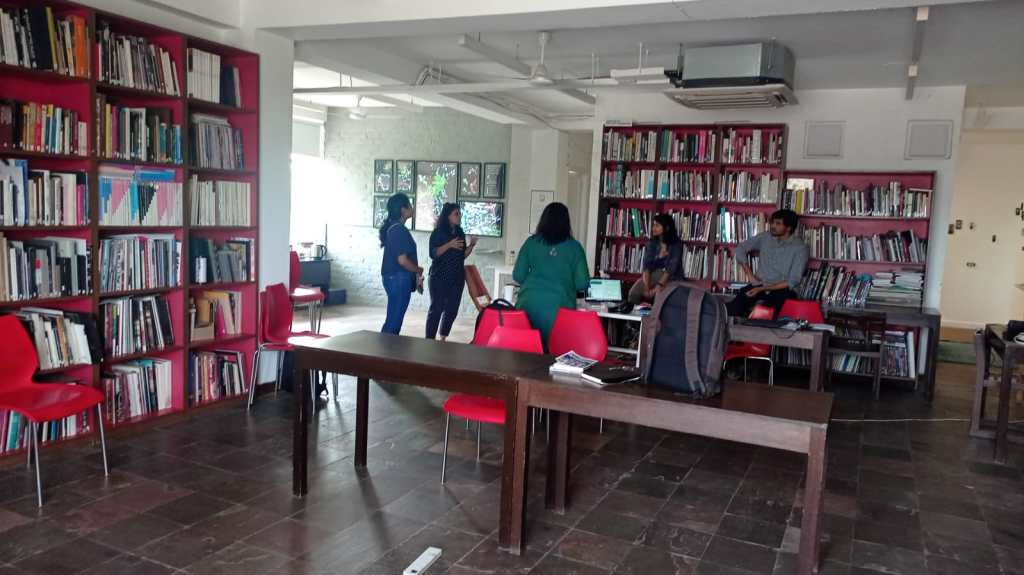
In this context, I want to take you through some of the work I witnessed and experienced in the out-of-line exhibition at the FICA Reading Room, which impact the larger ideations of MGK. Krishna, the associate director, and I are often keeping our eyes and hearts open to see how different places are run, where they are situated, and how they house these intersectional dialogues of politics and art to understand what kind of spaces to create. At the end of the day, the Mobile Girls Koottam is a space, the performance convenes the space. And I was in Delhi, to learn what else our space could be.
[Notes from exhibition pamphlet and websites in red. My notes are in black]
-out-of-line-
is a (re)assembly, framework and invitation to work through readings of networked and telecom infrastructures, and their affective possibilities.
During the month-long period of inhabiting the FICA Reading Room, phrased as an act of falling through a signal, -ool- (Aasma, Sonam, Suvani, Radha, Kaushal…) toy with the site of a signal as a porous and modulating situation while pursuing questions of public participation. The processes, conversations and observations accumulated over a year are revisited, compiled and annotated as exercises in tracing and reflecting upon the cross-connections, overlaps, disjunctions and claims.
The assembled display engages with practices and methodologies that have informed our process and that probe into the nuances of telecommunication networks and infrastructures at various interfaces and scales of cultural, political, social and personal life – from the inability to ‘connect’ to navigating the IVR trails/travails of a call, from turning the cracks of a phone screen into a canvas to sending out daily messages from a disabled dictionary, from decoding encrypted dialects to automated doom-scrolling, from an in-flight playlist broadcast over radio to plotting maps of occupied territories, from a sonic publication to screenshot-zines, from spectral readings to notes and other musings drawn from within the depths of the call – all of this absorbed, and reflected while falling through a signal. This project is supported by the FICA Public Art Grant 2020.
Unrequited Doomscroll by Tasneem Lohani
Video on loop, shot on DSLR, 6min 33s, 2019
Tasneem’s work probes into the excess of unlimited content, auto-play algorithms, compulsive doom scrolling that then begins to escape the reliance or need for the screen. As dust settles on the screen of a phone that relentlessly circles through a playlist generated by the YouTube autoplay suggestion system, Tasneem documents the passing of screen-time in other ways.
Tasneem and I had been booked into the same hotel room and her check out and my check in collided by a few hours. So, I got to meet her before I understood her work. First and foremost, it was good to know that we were staying next to a market area, with a lot of food. I was very very hungry. I had also doom-scrolled all the way from Chennai to Delhi, because I am not a very Delhi person for multiple reasons. It was nice to be welcomed by someone who has lived in Chennai and knows why I need my rice to get on with the day. She also let me know the good shopping haunts, but I just needed food. I walked around everywhere until I found a Korean place and ordered myself a big bowl of bibimbap to eat as I drained my roaming data with watching Only Murders in the Building on Hotstar. The mobile phone is a third arm, an escape hatch.
In the evening, I met Suvani at a coffee shop, got my shots of caffeine and nicotine, and had a free flow conversation about my existential crisis and thoughts on productivity and the structures of office and whether they are meant for me (maybe they are on some days). Before we planned, she shared a bit about some of the work and discussions they have had with the out-of-line exhibition, after all I had come in on the last day. The one she was particularly excited to share with me, that too rightly, was —
A non-profit radio broadcasting 22 hours a day, 365 days a year to over 500,000 listeners in Gurugram, Haryana. Listen via 107.8 FM in Gurgaon or online via apps. A critical information and communication bridge in the community using participatory radio. Linking residents to local administration, doctors, lawyers, counsellors, and to each other.
I had missed Aarti Jamain’s session on the experiences of this community radio, but it was heart-filling to hear the stories of women who had found some amount of expression and freedom through stolen phone calls, to pass their time and inquiries in the public domain. When we began the Mobile Girls, online podcasts was not a thing. But every time we try to even think of bringing a camera into this, we set into a discomfort of somehow trying to ‘sell an idea’ with an image of a living person. The audio format allowed the women to choose within anonymity and being known. It allowed us safety. It allowed us to think beyond insecurities. I am someone who hates phone calls, but sometimes phone calls also allow me to access certain conversations which I might not be able to do face-to-face, due to inaccessibility, fear, safety issues and more. The mobile phone is protection.
“There’s a Vicious War Launched in the Area of Frequencies” by Jumanah Abbas.
Maps, Light boxes, Various dimensions, 2023
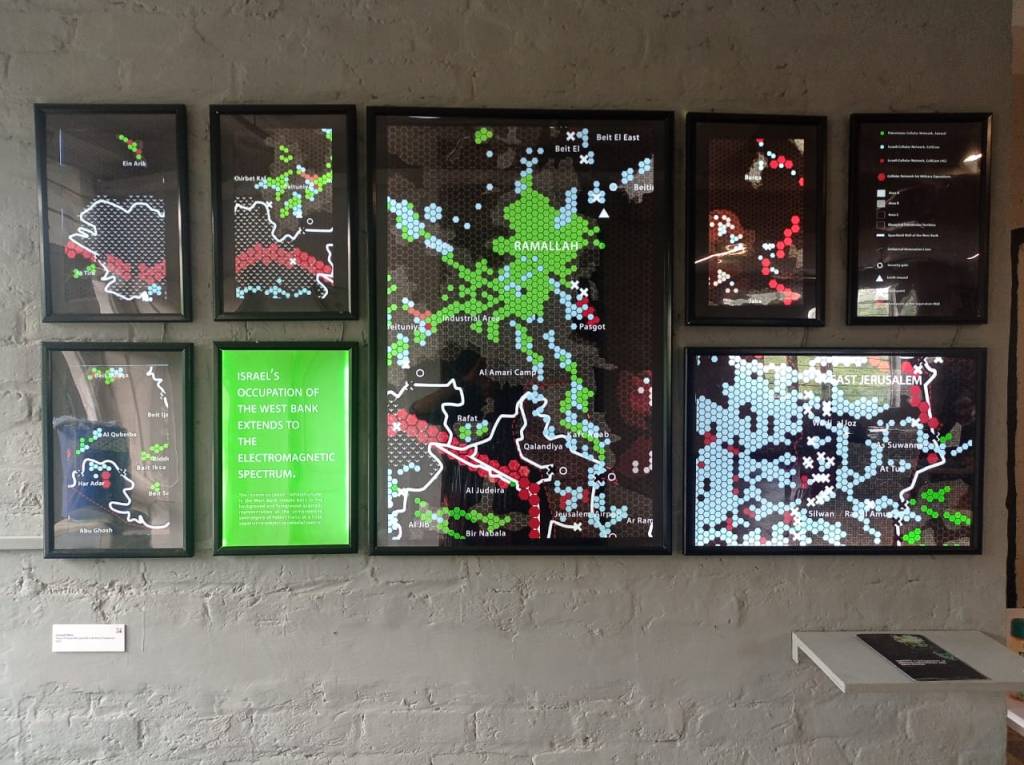
‘Jumanah’s practice contends with telecom infrastructures as sites of mediation, domination and contestation vis-à-vis her ongoing inquiry into the appropriation of cellular networks in the Israel-occupied West Bank. Through her mapping investigations, she unpacks how transmission of 3G signals follow a particular spatial order of territorial demarcations that are imposed on Palestinian territories of the West Bank.”
As soon as I walked into the exhibition, while they were speaking to me about how I wanted my coffee and where to get me some rice or biryani, I was raptured and pulled in by this shocking piece. I immediately clicked a photograph and sent it to my long-time friend and collaborator, Kirthi Jayakumar. There are few comrades you do not have to explain that at every breathing moment you are thinking Free Palestine, Kashmir, Manipur…… More and more internet blackouts and phone network blackouts are becoming government tools to silence dissent and dissemination of truth from areas under occupation and control. You can read more here. “The mobile phone is political.”
Did You See Me This Time With Your Own Eyes? by Shadi Habib Allah
Single Channel HD, 7 min 10s 2018
Following the rumour that the Egyptian government has acquired devices capable of tracking phone calls and conversations, some Bedouins in the Sinai Peninsula have been using 2G phones for communication under the impression that these are better shielded from surveillance. The Bedouins who traverse the desert regularly, have even developed coded dialects that are inaccessible to the rest of the population/region dwellers. The artist acquired some of these cryptic conversations and with the aid of a few Bedouins, managed to translate some of these dialects. He asked a hardware designer to encrypt the conversations and their translation on mini computers. The prelude to the work starts when a group of Palestinian engineers are given these mini computers. They are commissioned by the artist to set up a DIY 2G phone network. If set up properly, the network opens the calls and provides translation on a screen. Through trial and error, the process becomes the carrying narrative of the film as engineers argue about methods and make discoveries to fulfil the task. However, the video remains ambiguous. The onscreen workers could well be Egyptian state authorities-their efforts directed at decoding subversive exchanges between members of the Bedouin tribe. In either case, through, their approach, the zeal of discovery, remains the same. What alters is the meaning afforded by the context-‘invention’ in the first case, ‘hazard’ in the other.
connecting… by Salman B. Baba
Stop-motion video, 67s, 2020
An effort to record the imposed silences, following the abrogation of Article 370 in 2019. The work is a collection of screenshots of phone calls made in an attempt to connect to family in Kashmir during the period of the communication clampdown.
This connects back to the maps of West Bank. The mobile phone is political. It is a witness of erasure and silencing. The mobile phone is dissent.
Shiv Shankar’s “Govar Toli”
Mobile phones, variable dimensions, 2022
‘Govar-toli is a Magadhi word, denoting an area where the Yadav community resides and is seen as immutable. Discarded phones become a portal for Shiv to play with the contradictions that arise in constant connectedness with a device that, on one hand, promises glorious futures and on the other, also becomes an anxious reminder of familial, structural regressions enforced by a caste society. The artist, having grown up in Gaya, Bihar, alludes to the routine telephonic conversations with his mother and intervenes in the daily realities of his family through the interface of the phone screen – sometimes through erasure and distortion, at other times through a playful rendering of journeys and situations in 2D game worlds.’
My first mobile phone was Nokia 1100, the sturdiest phone ever produced. I had actually dropped the phone from a terrace and it survived. It had fallen multiple times into buckets of water and survived. I had spent many hours playing Snake on it and composing rudimentary tunes on it. This 1100 phone was also a connecting point in understanding that the Mobile Girls were the ones who had made it with their own hands. The production journey of the Nokia Sriperumbudur factory started with the 1100 model and ended with the 107 model. What Shiv Shankar is playing with here, also connected with the reason we have Lakshmi’s phone call with her mother and Satya’s love story splattered across phone calls. The mobile phone is an everyday reality.
Disable Dictionary: South Asia Edition (Speech Therapist Approved) by Resting Museum
WhatsApp messages, voice notes, 32 days, 2023
This virtual iteration of Resting Museum’s ongoing building of the Disable Dictionary focused on words as the backbone to a society and explores what the daily act of sharing the sound, texture, knowledge and nuance of a word might possibly do. Over 32 days, daily Whatsapp texts and voice-notes begin to stack up like a spine asking the question – how flexible really is language and the ideology that it produces?
The mobile phone is a dialogue on accessibility.
anumanlok by zeropowercut
Interactive Voice Response System, Data Phone, Bhojpuri-Hindi, 2023
Like most things meant for the public, and built upon rules invisible to the public, the format of IVR and its commands (press 1 for x, press 2 for y) encode the limit with which a heavily scripted language operates. Anumanlok enters this limit, and expresses how unstable the interdependence of language and meanings are, while still being locked in a code. The sayings of anumanlok come from a decade-long practice of archiving what was thought, spoken or heard in a sudraverse, that uncamouflaged in parts many of the unknown known laws that realise the backward as unintelligible. These texts in themselves, are lacking, but it is important that we hear them like that. It is important that we struggle to understand.
I had an interesting conversation with zeropowercut about what he had attempted to create. I loved the use of these phone helplines as a framework to tell stories. All of these works open up several possibilities of how we can use mobile phones as props, mediums, and characters in the Mobile Girls Koottam experience. It has been an ongoing conversation. Would we take selfies with the audience? Would we have mobile phone filmmakers during the performance grabbing snippets of the experience? Could we create frameworks through phone calls to and from audience members? The mobile phone is a landscape.
No, this is not all the work done by the -ool- curators. Please browse the blog and reach out to them.
I really wished that we had brought the show to Delhi, but it will be good to find a way to coordinate with at least some of these works and find a way to bring it into our show, in some way. This requires some deliberate thought and inquiry.
After the reading, one of the important pieces of conversation was brought forth by Raqs Media Collection Suddhabrata Sengupta, who has reported on workers strikes in the Maruti Company. He wanted to know how we plan to weave in the story of exactly how the Nokia factory shut down and the uniqueness of how its union was formed. I did explain to him that there is a reason we don’t do the play in a very documentation manner of perspectives, but through the speculations of the Mobile Girls, but in my further posts about the shows in December, I would have readdressed this.
Another important discussion was about the telecom bill (which I will come to in later posts)
The night extended with talking about safe spaces, artistic prejudices, monkeys, beer, exhaustion, rest and from here on what is going to happen.
Let me leave you with a visual from one of our works during the research and protests against the Nokia factory shut down.
Kalpana assembles a mobile phone (Stop motion filmed by Sudharshan for the NITS union’s documentary Disconnecting People)
THE MOBILE PHONE IS LABOUR
 The Mobile Girls Koottam
Leave a comment