09 December 2023.
Koogai Thiraipada Iyakkam, Valasaravakkam, Chennai.
Aparnaa, Krishna and I had met a few times on Zoom to discuss where these efforts could be systemised and taken forward. We made lists of community halls, and even reached out to a few initiatives to see what could be done to realise the dream of the moving stage. However, my mental health was slipping and my plate had just become too full for me to run behind everything and “get things done”. Nevertheless, we did get show dates fixed and somehow I was not very satisfied with where to bring back the show for it’s one year anniversary. Over this time period, Aparnaa had also started to get busier and she needed to move on to her own artistic expressions and work.
Several times over my career in theatre, I have been met with the question, ‘Sam, why don’t you start a group?’ My biggest fear of starting a group is stasis, somehow making people feel obligated to a piece of work, an ideology, a space, or the group itself, its members and the larger umbrella, or worse, obligated to me! Yes, I can still imagine and will work towards creating the Mobile Girls Koottam into a moving space of dialogues about labour and women. However, the structure has to be hybrid enough for people to come and leave.
I have had this dream of starting a tea shop since the 2000s. In college, completely disillusioned with the idea of compartmentalising people into disciplines who rarely met during allied classes, certain cultural events and canteen breaks, I saw that the “college” and the “university” was absolutely disinterested in knowledge exchange, collaboration and a concern about the world outside the campus or even within the campus. At this point of time I started a blog called Chai Kadai, under whose banner I also produced plays for small festivals, and kept the platform open for different kinds of dialogues from activists, artists, thinkers, filmmakers, students and more. Could this have become something? Is it still on its way of becoming something? I ran it for over five years, but after a certain point of time when I began discussing a physical offline manifestation of this tea shop, things did not kick off into larger conversations until I met the Mobile Girls. I, however, filled notebooks with sketches of ideas of tea shops that run a year long residency, where every quarter the shop is run by someone else and in a different place. Let me see if such things become a part of the Mobile Girls Koottam dialogue over time.
Finally, half way into the sleep state, I suddenly remembered that the perfect place to take this show is the “Koogai Thiraipdada Iyakkam”. I have been meaning to go there and have followed them since the place was established, but sometimes I only go to places when there is a concrete reason for me to be there. Krishna went and checked out the place and saw the dimensions and how it could house the show.

Here’s how Selva from Koogai introduces the space, “The name Koogai represents the owl. The owl is treated as an ‘untouchable’ in the kingdom of birds. It is blind in the mornings and can only see in the nights. It cannot hunt in the mornings and the other birds attack it. But in the nights, the owl is the king. So building on this metaphor of the owl, this library is the torch which guides the part of society that has been oppressed into darkness back into the spotlight. It was established by Pa. Ranjith of Neelam Foundation. The space is a movement. It is an important platform for new Tamil film directors and assistant directors. In other places, they would have to pay fees to attend discussions with established directors in the industry. In Koogai, all the discussions and events are free. We specifically focus on screening and discussing films that have spoken about issues that are usually disregarded in the mainstream, even if the films are not technically perfect. The discussions are open and we also encourage critical questioning on how films engage in political dialogues, whether in wrong ways or innovative ways. Most of the people who come here from interior Tamil Nadu have misconceptions about what cinema is and the dialogues in Koogai helps them to critically assess what cinema can be. By interacting with the comrades in Koogai, they will be able to expand their lens of political understanding of the world and unlearn how they see caste, gender, race, body image and so on… Every day we have discussions about film, short stories or novels, and we look at how representations happen and open these dialogues. I really think that it is very important that directors need to build a reading habit and in Koogai we also encourage reading fiction. We critically analyse the political frameworks of short stories, world cinema, Tamil cinema, cinema from other parts of India and in other languages, and even novels. The idea is to build a movement of progressive thinking in the directors of Tamil cinema. It is a political movement to understand what the cinematic screen has spoken until now and how it has done so, and what does it have to talk about today and in the future. “
Could the Mobile Girls Koottam find a better home?
Since Aparnaa had to move on with her work, we had approached Malavika PC, a performer and visual artist, and one of the founding members of Radio Potti, (also my sister), to join the cast. However, I did not want her to play Kalpana. There were two reasons. The character of Kalpana is a strong voice of the Dalit, communist and feminist movement. It had to be someone who had traveled with the play for longer. Also, somehow when I saw Malavika as part of the play, I felt it could give a different spin to the character of Satya, who does not use the terms ‘feminism’, or ‘anti-caste’ movement, but she is a woman who will do anything to hang on to her career dreams and has an inter-caste love story which she plans to bring to fruition by securing her career dreams. Now, this meant two actors in the show had to take on new characters. When this was floated, Atchaya was unwell and at first curious about why I had thought of her for Kalpana. The conversation we had after the Arsu colony show made me feel the questions that Kalpana will throw up over the next couple of shows would be something I can approach with her. I was curious to see what she would do with this. Moreover, since there has been a big gap between the March shows in Bengaluru and bringing the play back together, somehow it was going to feel almost like a new play to everyone. Again, it was not like we could meet together and rehearse until the morning of the show. Once Atchayaa’s health got better and she wrapped up some of her other commitments, she met with Malavika over Zoom to see how they could help each other. Yazhini helped Malavika rehearse and practice the songs.
And then… On December 4, 2023, the severity of the Michaung cyclone hit Chennai and southern parts of Andhra Pradesh. As I write about the devastations that were caused in the city, at this moment, the southern parts of Tamil Nadu is under water, experiencing unprecedented floods. The cast lost touch with each other. Not everyone had power banks. Every road was inundated with water logging and fallen trees and broken electrical transformers. We did not know how our comrades in Koogai or Urur Kuppam were coping. The entire city lost electricity, cell networks and a sense of safety for two days.
It was worse than what happened in 2015 and no amount of satire could help us out of it as it unravelled.
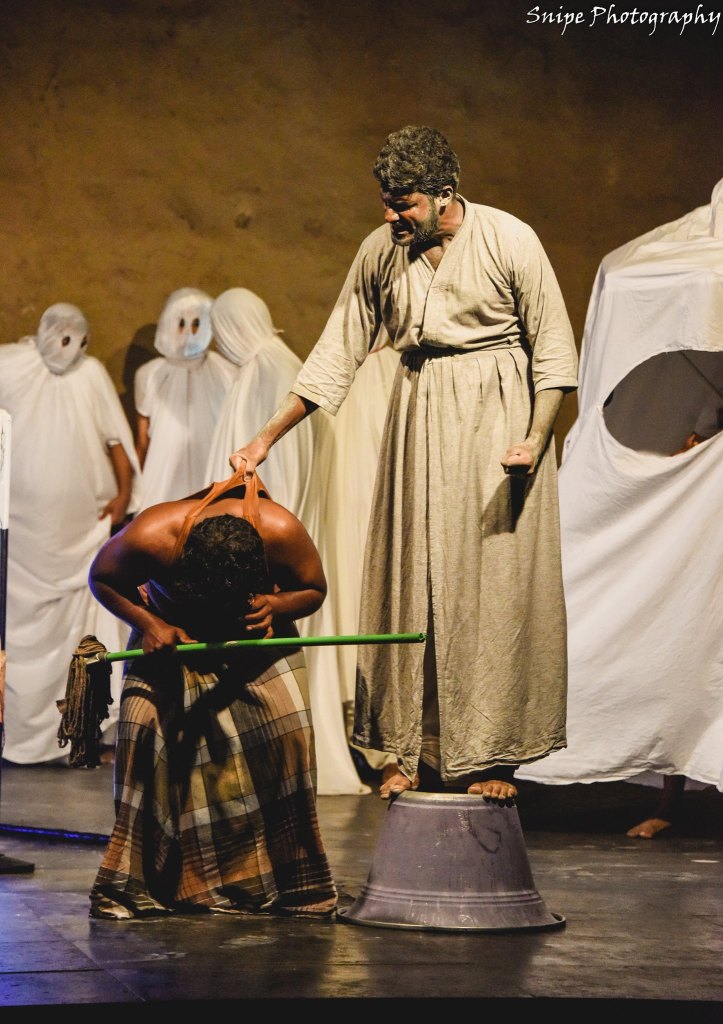
Cast members were stranded in different houses. The children didn’t have milk. 100 year old trees were uprooted. Over 40,000 people were evacuated. Oils and effluents from factories flowed on to the roads and into houses. Sewage canals overflowed. The city was in no situation to handle the flood. Hospitals were inaccessible. People lost their lives and livelihoods overnight. Even the streets could not house the homeless anymore. The city is still on its way back. Restorations are on the way, and the government is busy responding to the floods in southern Tamil Nadu. The fishermen and cleaners employed to clean the oil spill in Ennore have not been provided sufficient PPEs and other protections. The situation is not something we can brush off and move on. Along with this is is the genocide of Palestine, looming over us, holding us hostage as witnesses who are not able to create any effective change.
Over this week, I had also lost a friend to depression. There was no way to keep in touch with the networks off and all I had was a Facebook update and no other contact to even be there for his family.
When we finally got back in touch with each other, it was grace to have heard each others’ voices and to know that each family and person had somehow secured themselves the bare minimums of safety. I wanted to go on with the show, once I knew that the areas around Koogai and the Tiruvalluvar Nagar Community Hall had also been restored. We had decided that these two shows would hold a hat collection to collect funds towards relief work in Chennai. One of the cast members was worried if it would be insensitive to call people for a show and ask them to be entertained and be joyful while this had happened. This is a very understandable question. Over this year, I have lost the will to argue and convince people to change their opinions or level of energy to do something. However, this was a dialogue I had to have. Is the Mobile Girls Koottam simply an item of entertainment? And should entertainment be denied to people in times of crisis? Or can “entertainment” become a way to celebrate and bring together community to open platforms for dialogue and action and create a culture of camaraderie?
The play is the creation of a space to convene dialogues on labour, gender, lifestyles, corporate exploitation, capitalism, survival, building communities and more. There was no other time that was more right to definitely go ahead and do the show. People were bombarding X and Instagram with complaints on corporation workers, without much consideration as to whether the workers’ houses were flooded. The cast member understood and I am forever grateful that despite the flood having caused much havoc to her own living situations, she made it for the shows.
We met in the morning for the rehearsals, kind of had some line run-throughs, but as usual I was focused on the process more than the product. It was almost like I was going to watch a brand new play and then figure out how to take it forward. One of the most important things for me to sort out with the cast and the crew was the after-show dialogue. The rehearsal before the Thiruvalluvar Nagar would focus on the dialogue during the show, and the rehearsals from here on will focus a lot on this, as it should. But, it made more sense to focus on the dialogue after the show on the Koogai morning.
Some overall rules were set for the after-show dialogue – no moderation and no pedestals. We will not ask for feedback, but open dialogues about the flood, Palestine, labour struggles and more. We truly throw open the floor and see what happens.

Malavika and Atchayaa had new characters. Selvi and Nimmy were also coming back to the show after long. Nimmy had listened to the podcasts over time and restructured her monologue to a better narrative and had brought in ideas of what a recipe meant, and how knowing the recipe provides certain kind of courage in what we are attempting to navigate. As she restructured, it also opened up space to discuss ideas like what happens when a very young girl gets her period.
When we reached the space, it was almost an unsaid sharing amongst the four women in nighties that there were a lot of men there. No, not all of them attributed this to feeling unsafe. In fact, two of the cast members surprised themselves that they felt this safe in a room full of men. One other cast member was more focused on her own involvement in the show and how to make peace with that. Selvi, however, felt both ways. She was initially very confident, but did share some reservations about how the men with young blood might take us talking about sanitary pads and condoms. I was busy browsing the book shelves and wondering how we might do the seating this time. I was happy to find a book by my father on the book shelf, which had given to them when they had first opened the library.

Krishna was busy with ordering the biryani (as we had decided to share a plate or two of biryani with everyone at the end of the show), fixing the TV (which was being a bit moody on that day) and overall figuring out if all of us had what we needed. Yazhini was busy being herself, getting a bit hungry, waiting for a packet of chips, and happily lying down on the mats. There’s a lot more to talk about how Yazhini is engaging with the Mobile Girls (which gives me the idea that I will do individual posts where I talk to each person part of this over time).
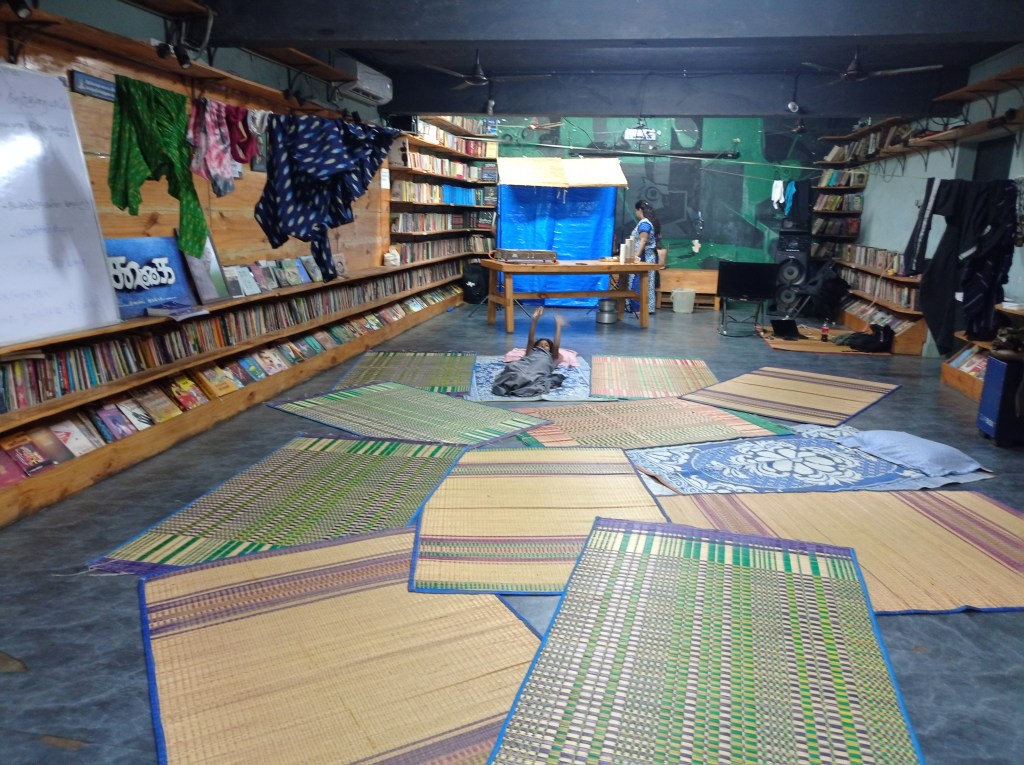
We had good learnings from the previous shows that the seating had to be deliberately haphazard and the people had to be encouraged to sit wherever they pleased, but we regressed back to the idea of putting the tea shop in one corner. This immediately cut the action into one angle for big parts of the show. Even though we had put a clothesline right in the middle, the cast got the clothes and sat next to the tea shop to fold them. When Kalpana and Satya decided to play cards and a few boys joined them, they suddenly cut short the cards game and got swung into the taking the “scene forward”. During the show, the cast completely blanked out several times. Selvi completely froze not knowing how to connect to the young men. The food was happily distributed. The men were extremely enthusiastic about the performance and its haphazardness that threw open so many important dialogues with a kind of flippant ease at them. They were confessing to vulnerabilities and still some chose to wear their macho masks. The goof ups were rib-tickling at most places where Lakshmi who really wants to get married suddenly in between the show decided that she no longer wants to get married. I had to literally almost become a complete part of the dialogue and for the first time I had to use the script to almost prompt and divert the dialogue to a circle. The songs were a hit. However, the pitching of Nagarum Kanavugal was so off that we could not even try to hit the high notes. We had one more show tomorrow, and my voice was almost gone with the constant direction I had to do to get the show going. Moreover, I was on the day of my period, my knees had cramped and I was bleeding profusely. My ankles felt like jelly. Finally, the plate of biryani was taken within the audience for everyone to share, but suddenly a cast member brought it back to the tea shop like it was some prop and then the plate had to be taken back to the audience. I was not the only one on the edge this show. We nevertheless got through the show, with a bundle full of excitements and a bundle full of disappointments. We laughed through everything and somehow that eased it down.
One of the men in the audience walked up to me and even asked me how I felt okay with putting up something like a rehearsal for them to interact with. Nevertheless, the ensemble that had convened for the evening enjoyed themselves and found the play to be an extremely interesting methodology. Before I move on to the discussion after the show, there are some things to notice about how these blocks put the cast at a situation where they were not even ready to have a dialogue during or after the show. For a moment, forget how they connected with the men who had come to experience the show, they had even blocked Naren out of the dialogue. The next show would get better for Naren, but still I made a mistake with where I made him sit. I had a better idea and went against it (shall get to this in the next post). What happens when you want to open a dialogue but find yourself personally inundated from being a participant? You do not get Brecht’s Verfremdungseffekt (defamiliarization effect, estrangement effect, distantiation, alienation effect, or distancing effect), because it is not deliberate, but something that is happening because the people in the process are suddenly floating in and out of effects, losing all sense of deliberations.
But instead what you are left with is almost an invisibilisation or minimisation of each other’s presence and your own, by forgetting the power of vulnerability. Another issue with ‘engaging for the sake of engaging’ was when Kalpana pointed at audience members when she wanted them to participate with what she was saying, almost putting herself in a power equation of ‘teacher vs student’, ‘parent vs child’, ‘activist vs common man’. Remember, the rule – no pedestals. Yet another logistical issue is when we decided to share the food during the show. This had already been pointed out to us during our first show in 2022, but somehow did not present itself to be an issue in the further shows. However, Atchayaa had given a completely different spin to Kalpana’s monologue and it had become an effectively emotive evocation on abuse, fatherhood, dissent at home evolving into the workspace and streets. It is getting somewhere and I believe with further shows we have an extremely important keystone in the play being crafted here. However, right before she began the monologue the bajjis had been distributed and the men were fighting to pay attention. I will not say that they were distracted, but honestly they had to fight amongst the commotion to perceive the heaviness of what was happening. (In the next show, it will throw up questions of what we need to do with this heaviness after it has been shared). Now along with this, another bigger invisibilising that was happening was of the few women in the audience, who were hardly even acknowledged.
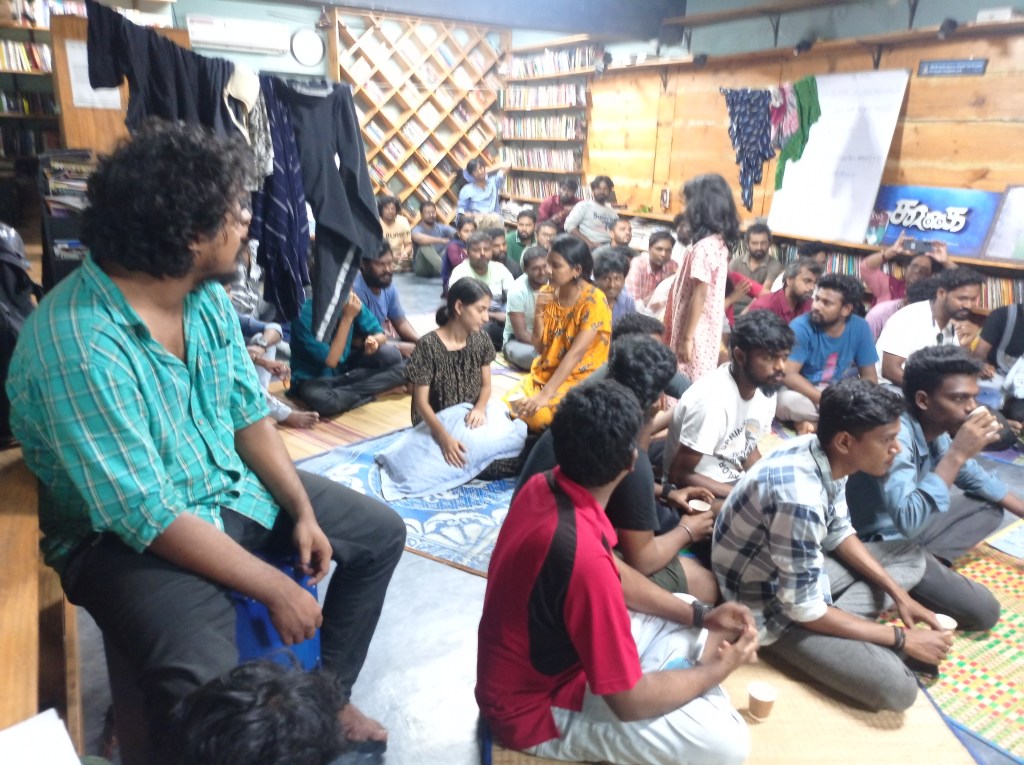
When the floor was thrown open for the discussion, the cast was emotionally and mentally still caught up with the “goof ups” that had happened during the show. Moreover, in the exhaustion I had forgotten to suggest that we change our seating to a circle. Nevertheless, the discussion kicked off in a significant way, as we first enquired each other how we had survived this week amidst the Michaung cyclone. From here, when the conversation went into Palestine, there were a few people who had come for the play that had come from extremely misinformed space. This did alarm both the Koogai community and the Mobile Girls community, but a dialogue does not get far if we simply decide people do not deserve the space to be misinformed. And so, some of them regressed the genocide of Palestine into two religions fighting over a piece of land. Though one of them did point out that the Balfour declaration had a significant role to play in instigating this conflict, they also somehow drew association to Rothschild and the Illuminati. The cast was not in a mind space to even participate. And the evening desperately needed context. The idea was that a discussion on Palestine would lead to some action development, but the most necessary action of the evening became clearing misinformation. And thus, I felt it was important to gently take this conversation towards Gujarat and Muzaffarnagar, the differences between faith and Hindutva, (no, I did not have the space to talk about the structures of Sanatana Dharma itself or the colonial idea of the Hindu faith, even though Koogai is the most apt platform to open these dialogues), the freedom to eat beef, Iraq, and Afghanistan.
The Israel Army, with great support from United States that desperately wants a non-Arab hold in the Middle-East, is testing weapons in Palestine. They are rounding up people, stripping them, making them pose with weapons, accounting civilians as terrorists, parading them on streets, bombarding hospitals with missiles, and ransacking homes and businesses, and mocking the existence of Palestinians. This is a genocide. There are no two ways about this. But it is very paramount that the dialogues about this genocide draws parallels to Kashmir, Manipur, Kurdistan and more.
If anything, in denying vulnerability, the discussion and the show had ripped us down to our vulnerable selves. Almost to the effect of let’s talk about what happened tomorrow morning before the next show.
As they packed up the props and put Koogai back into place, many people came forward to talk to the cast and me about different things, especially about cinema and direction. A lot of them wanted to know how I direct actors to be so raw and real. You see, inviting such a conversation on a day you are completely overjoyed with the cast is a different thing and it is a completely different animal when you are sorting out how to dole out feedback to them tomorrow morning, because there is a very integral misunderstanding of the process in the show itself. However, the audience did not perceive this as misunderstandings. There were questions on how to direct for the screen, and how to look at subtext and what was satire. I was really up to having such conversations, but I will stick to my understanding that directing for the screen and the stage are completely different games to play. The stage is about live experience where you want the actor to be completely present and deliberate and aware of the experience they are creating with the spectator and then to be able to on spot direct themselves to enhance that experience with the purpose of the show in mind. However, you direct for the screen with a much a larger picture than what the actor can even afford to have. They are completely different languages. Even though I did not do a satire on the flood, it is satire that helped us survive this week. And satire as a genre deserves it own long post with all my notes on why I find joy in using it as a medium to open political dialogues.
Before closing these notes on the space and the show, one of the important conversations was about how the library on that day had a predominantly male audience. The Koogai movement, however, does not perceive itself as a space for men, and are constantly making efforts to involve women and the queer community into its dialogues. The reason many young men come to this space is because men do find it socially easier to negotiate the freedoms at home, with jobs in delivery services or cab services, and they are able to make it to the library more regularly to pursue their dreams in cinema. It is important to note that not just in Koogai, but across Tamil cinema, it is extremely difficult for women to negotiate spaces especially in the directorial vision of the industry, unless they come from significant caste (and corresponding class) privileges. This gives the Mobile Girls Koottam movement a bigger purpose of traveling the space to where women can find it accessible and a starting point to negotiate their dreams with themselves and their families. All the more, the journey of our Selvi becomes the fulcrum of this movement.
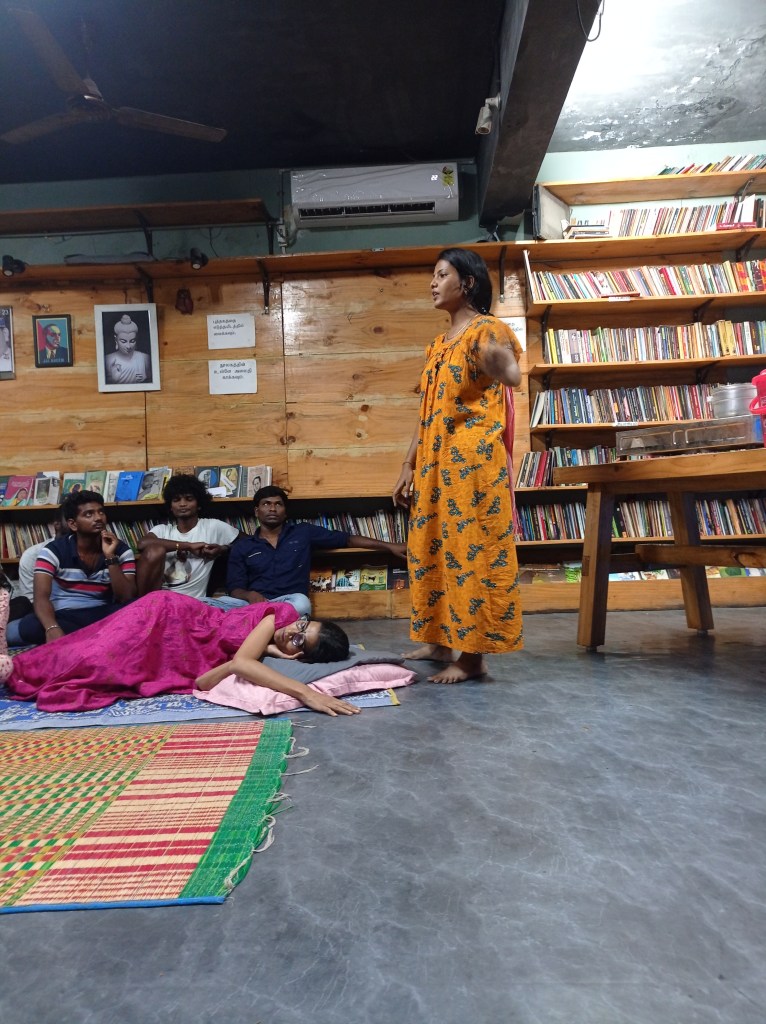
 The Mobile Girls Koottam
Leave a comment