March 2023 – On the way to Bangalore
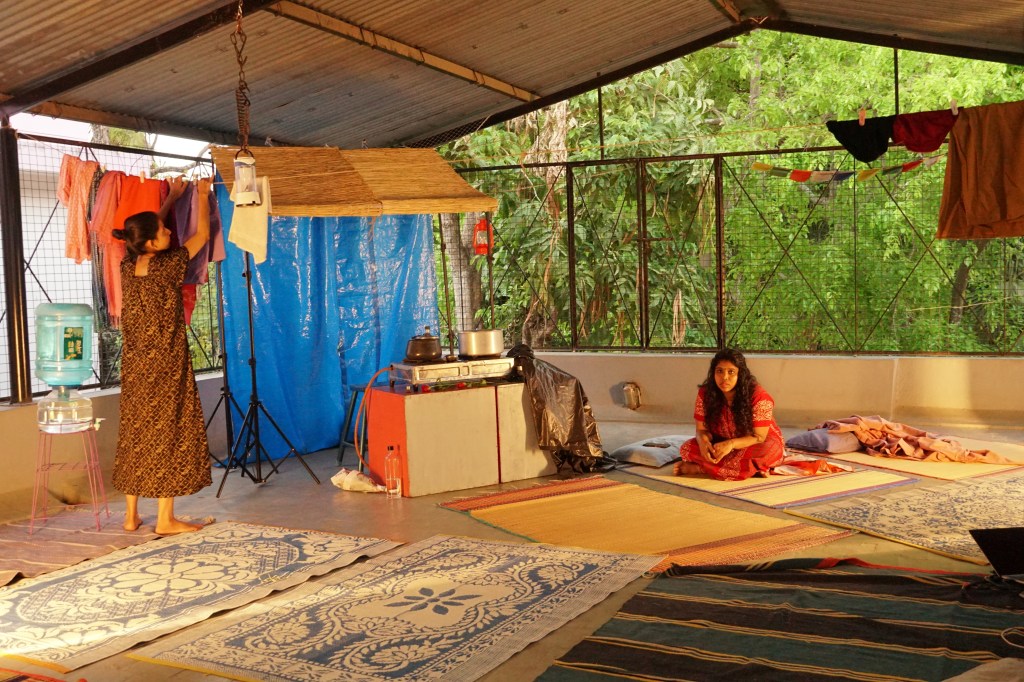
As I take you through the next set of shows that happened in Bangalore and what happened to the show in the following months and our way forward, it is going be a lot of personal reflections on “productivity” itself as an idea.
We began this year attempting to organise shows in interior Tamil Nadu, but some bureaucratic delays did not make it possible. At this moment of stagnation, Ekta and the Maraa Arts Collective invited us and organised four shows across Bengaluru city. They launched a crowdfunding campaign to host us and many friends and new allies generously contributed towards our stay. This chapter of the report focuses on my thoughts regarding preparing for a show and managing its chaos.
When we set out to do the first show of the play, we had to rush with it the adage, “the show must go on”. It was our only window of time to show it to Madhumita Dutta, the beginning of all of this, along with Kalpana and Beula’s family. We had to do the show with whatever we had in hand. The crises that needed to be handled were not one or two and the severity of it wasn’t something that could be swept under the carpet. This narrative report is an essay on work ethics and the honest brutality of being human beings.
I am not someone who believes in highly moralistic frameworks for creating a piece of work. Life happens. People mess up. People fall ill, mentally and physically. And theatre is about understanding these boundaries and creating something together.
Leading up to the first show in December, I had to also maintain a full-time job and do things for my family, sitting in a house in the outskirts of the city. To some people outside the realm of what I am, they make comments like, “I don’t know how you keep it all together and get things done.” The honest truth is that I don’t have it all together and immensely struggle to get things done. Some days are better than the others.
When it comes to an artistic perspective in theatre, especially for this piece, the script is only a guide and a framework within which the ensemble can move and find out how to access the purpose of the performance and deliver or create it. It is not something set in stone, but something that develops over time. Specifically, this is more so with The Mobile Girls Koottam, because it is heavily dependent on how the audiences interact within it. The purpose is not create awareness, entertain or start dialogues, but to learn from the dialogues that are being created. There is a deliberate embracing of messes and rawness that can sometimes be unsettling to the audience walking in expecting “art”. It is everything that is not the factory. It is not a quality checked product made within neat lines. Is it possible to create something like this? Is it audacious to impose something like this on the world?

Why are these things not better choreographed? Why have they not rehearsed these pieces until they feel it in their skin? As we go through this report, I hope that I will be able to provide this understanding to you.
On the days leading up to the play, the cast and crew came and stayed with me in my house for two days. The days were purely messy, dramatic, chaotic, tiring and yet very beautiful. I don’t truly know how to make peaceful work. My heart is always on my sleeve. My problems are for everyone to see. I don’t have clear professional boundaries when it comes to my reality, for I feel they are not necessary in art. It can be nerve-wrecking to work with me as I try to piece together what I feel about something. It is not for everyone.
One of the biggest events of that weekend was that my mother after so graciously and with a kind heart helping the performers access their dialogues better and giving us all the critical reviews to put the play together, had a big fall and hit her head. Unfortunately, everyone in the cast and crew had to take care of my mother, me and themselves during this mishap. It scared us. It shook us. We were dealing with grief, mismanaged depression and an accident. We were dealing with yet another artist finding it difficult to grapple with life. We were not all equipped with the best tools, but we tried our best. Was it okay for me to impose this upon them during rehearsals?
Another issue that we had to deal with was that an actor was unfortunately a whole day late for rehearsals because their mother needed care. There was a lot of talk about the character of the person and the high moral values that if someone respected the piece of work and the rest of the people, they would be more communicative about it. Sometimes it is not as simple of how much people respect the other people involved. Sometimes life is overwhelming and sometimes people mess up trying to deal with something else that becomes a priority. Character assassinations do not allow us to open the doors to empathy. When she finally made it to the rehearsal, she put in the work to access the piece at the high speed required with the show going to happen tomorrow. She was also part of the group that helped me take care of my mother, my child and myself before the show.
I cannot approach creative production and art like we would approach other work. This is maybe something I have to unlearn in other situations, because deadlines, smaller expressions of trust, respecting the piece of work as sacred, being grateful for the opportunity and space matters more. But let us deliberate on this word sacred a bit more for a second. Devotion comes in different forms. I am not talking about organised religion or systemising devotion. I am talking about the feeling and journey of devotion. It tests the edges of sanity.
Art is very close to this. In all the things people could be doing with their days, some of us are drawn to art from the pit of our stomachs. If we chose to lose and win in any industry, why would we chose art where the chances of winning are so very thin? Each person who walks into the making of art, walks in with their own sets of prejudices, and lived experiences of oppression and repression. They are coming into this space to find themselves through spreading a certain kind of a joy or experience to others through the stories that they are choosing to tell.
So, for me is it such a character flaw that the person could not make it to one day of rehearsal or find a way to keep us informed? Is it such a character flaw that my family issues leaked into rehearsal time and stole peace? Are these flaws or spaces for us to grow? Spaces for us to step in and be there for others. Not to blindly support them, but to simply understand and get on with finding a way to do the work that we want to do. How does one draw the boundary of self-care as being more paramount than the work at hand? We live in a world where self-sacrificing for the larger goal is romanticised. We make-up rules that this is the only right way to be when working. We celebrate people who did not land up for funerals because they had work or people who sacrificed meals to finish work. Maybe, there is a way to create space for humans to be humans and still draw boundaries for ourselves to get on with the work.
So, when the cast member did not land up for whatever situation was holding her back, which at the end of the day was something anyone should have dropped work to take care of, did it really matter if she was being communicative or if she as a human was taken care of at that point of time? We moved on with rehearsals putting a pin on her character, taking her lines, while my head was also trying to see if the possibility that she will not come for the show could be true, was there a way to merge the character into the others.
I would like to divert here and talk about three of my other plays – The Sunset Sister, An Empty Carousel at Sunset and Frankly Speaking – and how I learned this quality of improvisation from others too.
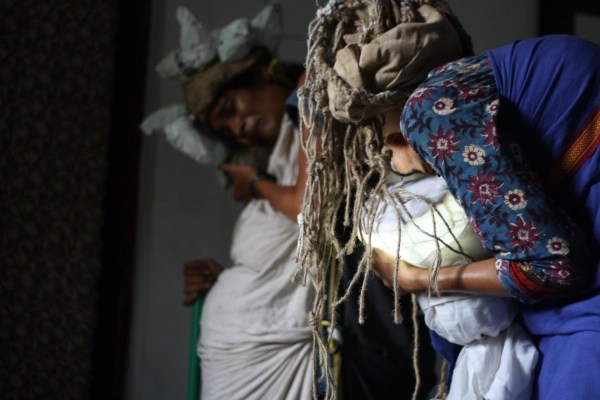
During the first performance of The Sunset Sisters, a ten minute play about two sisters on an island who fall in love with an imaginary creature, the actor playing the younger sister suddenly lost her voice. We had three more shows to do. She also happens to be my elder sister in real life. While it might be fine outside this context to sit and discuss whether or not if as actors we must take better care of our bodies so we can give our hundred percent to the show, what could be the more humane way of dealing with this and still doing the show? When presented with this question, the other actor suggested that we use the harmonica as a tool for her to voice, and we will simply remove all her lines. There must be a way the music can convey something even deeper than the lines I had dearly written. The ironic thing was that my sister was very adamant that I write a script and pushed me to deliver it, when I hate focusing on the script in theatre. And here she was now with no lines, but an entire story to build and play with using the harmonica. This entire process was a big learning for all of us. The show was not the time to get overly critical or analytical as to why someone lost their voice, but to make space and make them feel like they haven’t lost their voice. We had four very beautiful shows, where people even went ahead and congratulated us for doing something so out of the ordinary and they had no clue that one actor had no voice to even thank them!
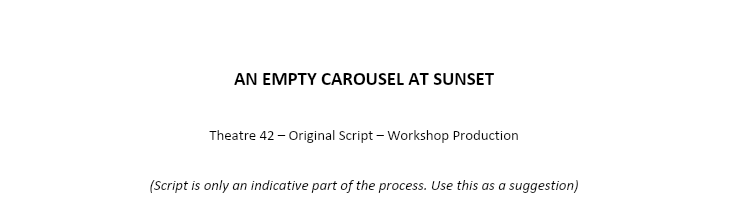
The irony of my disclaimer is apparent in the note below
During the shows of An Empty Carousel at Sunset, which is about a man breaking the monotony of his life and embracing the surreal craziness of his dreams, I had created a Sutradar/Soulkeeper character. This particular actor had already worked with me once, but he was in a different mental phase during this performance and wanted to experiment. Somewhere he thought he had that space to do this with me, but somehow during these performances I had totally lost all patience for improvisation. Instead, I was vile and shouted at him for continuously surprising me and not giving me something consistent to go on as the beginning of the play. This is the same person who had given the disclaimer that the script was merely indicative. We still went ahead with the shows knowing I had created a traumatic experience for him. It stayed in my mind for many years and we lost touch with each other. Many years later, we happened to be colleagues again and he had become a very quiet person, albeit strong, but somehow had a deep silence. For a moment, I took upon the entire blame for silencing him. Again, see I was not really asking him, I was just assuming. Then, we worked together for weeks, until I mustered up the courage to make peace that life happens to everyone and went ahead and apologised to him in case he is still carrying the heaviness of the rehearsal room with him. It was a sweet and gentle conversation of humanity. It was a space to understand we are both human and there was no right and wrong in this situation.

During the second run of the shows of Frankly Speaking, which is an immersive play about genocide that strings voices of women using Anne Frank’s diary as a spine, I had made a creative decision of how immersive it would get and went all the way to stamping serial numbers on the audience members hands like done in the concentration camps. One of the cast members was very uncomfortable with this and we had a long conversation on chat, but I chose to stick with this decision. When I think about it today, I do not agree with my decision but not for the reasons she did not agree. There was a lot of trauma reliving in that play and this was one more addition. But I particularly don’t agree to it now because by putting the serial numbers on the audience members, I made all the victims of war and stripped away the nuance of the immersion that could have also brought about the discussion of when we are apologetic or supportive or participative with the perpetrators of violence. I had limited their experiences to being victimised, instead of wondering if vantage points of being the perpetrator could also have been immersive. Anyway, after this discussion there was a radio silence from the cast member and on the day of the show after several attempts to get in touch with her we heard that she will not be able to make it to the play due to health issues. The issues can be true and not so true, but that skips the point. The person could not make it. Now, does that make this person a bad person to work with? The onus of putting together the show fell on the other actors and they were more than triumphant in doing it. However, on that day, the play fell flat for us. It had lost the nuance because there was unprocessed anger.
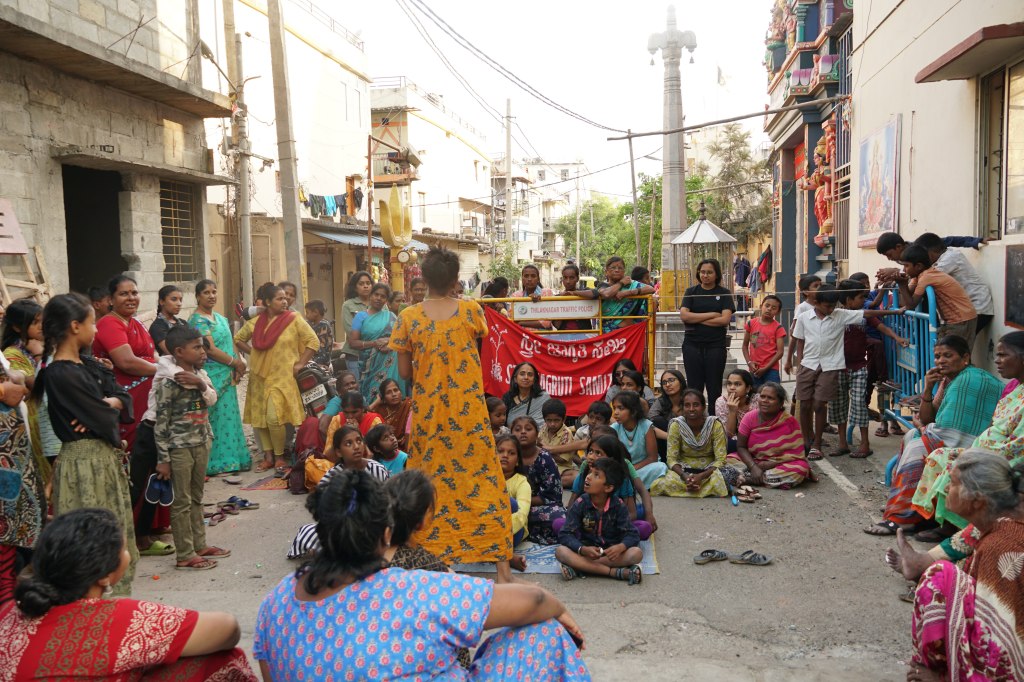
Let me come back to the putting together this ensemble for The Mobile Girls Koottam. Over the last six years, I have tried several times to cast this show and kick it off, but it was very difficult to find synergies in time and intention with people. We would almost start the show and drop the idea of doing it so many times. Somehow in 2022, the synergy started to form itself. The first two cast members who were signed up were Aparnaa Nagesh and Selvi, two very vastly different women both with deeply personal relationships with me. Aparnaa and I have followed each others’ lives and work and collaborated multiple times. Selvi was the caretaker of my child and we have had several long conversations and action points on things she wants to do in her future. We needed two more women to join the cast and I had asked Aparnaa and Dushyanth, another colleague in the theatre fraternity, about options. I had spoken to quite a few people. The conversations with Atchaya and Nimmy materialised after they had read the play and seen a way to participate in a process and methodology, which is still not down on paper or tested out. We had several Zoom rehearsals and had decided to meet only two days towards the show. Why did I believe this was enough time together? What was I chasing after? Was it only purely improvising with the logistics of bringing people together despite varied schedules? Was it only because I could not make more time beyond this with doing a day job? My idea was that there is no way we could build false delusions of what this play is, unless and until it meets an audience.
This whole process shifted me from “the show must go on” to “must the show go on”.

 The Mobile Girls Koottam
Leave a reply to malavikapc Cancel reply